Dettifoss Facts That Surprise People Who Have Already Been
Short answer. Dettifoss may or may not be Europe's most powerful waterfall, depending on who is measuring. Its water is brown. It is moving upstream at half a metre a year. And the best-known story about its neighbour Goðafoss appears to have been made up in the nineteenth century.
Everyone arrives knowing one fact about Dettifoss, and it is the one fact that is disputed. Here are the ones that hold up, and the two that turn out to be more complicated than the sign says.
1. The European record depends on what you measure
Vatnajökull National Park calls Dettifoss the most powerful waterfall in Europe. So does Visit North Iceland. Wikipedia calls it the second most powerful, after the Rhine Falls in Switzerland. Nobody is being careless; they are measuring different things.
| Dettifoss | Rhine Falls | |
|---|---|---|
| Drop | 44 m | 23 m |
| Width | about 100 m | about 150 m |
| Flow | 193 m³/s average | 250 m³/s winter, 600 m³/s summer |
Rank on water volume and the Rhine Falls wins comfortably. Multiply volume by the height it falls from, which is what determines the force arriving at the bottom, and the two come out within a couple of per cent of each other. That is why both claims circulate. It is also why standing at the lower viewpoint feels the way it does.
2. The water is brown, not blue
This is the thing first-time visitors are least prepared for. The Jökulsá á Fjöllum leaves Vatnajökull carrying rock flour — sediment ground off the bedrock by moving ice — and that silt turns the water grey-brown all the way to the sea. If you have seen photographs of Gullfoss or Selálandsfoss and expect the same palette, Dettifoss will surprise you.
The silt is not incidental. Water alone does not cut basalt quickly. Water loaded with abrasive sediment and dropping forty-four metres does.
3. The waterfall is moving
Vatnajökull National Park records Dettifoss retreating upstream at about half a metre a year. Over a human lifetime that is forty metres. Over the eight thousand years since the floods that opened the canyon, it is the entire Jökulsárgljúfur. The gorge behind the falls is a record of where they used to be.
🏛 Did you know? The three waterfalls on this stretch — Selfoss, Dettifoss and Hafragilsfoss — are the same process at different stages. Selfoss is 600 metres upstream and wide because the river spreads there; Hafragilsfoss sits where Dettifoss used to be.
4. The name means the collapsing falls
From the Icelandic detta, to fall or to collapse, and foss, waterfall. Icelandic place names in this canyon are relentlessly literal, which is its own kind of charm. Selfoss is the ledge falls. Hafragilsfoss is named for its ravine. Jökulsárgljúfur is the glacial river's canyon.
5. You have probably already seen it
The opening sequence of Prometheus (2012) was filmed at Dettifoss, standing in for a primordial Earth. Ridley Scott used the canyon precisely because it looks uninhabited and unfinished. A number of visitors arrive recognising the shape of the place without knowing its name.
6. The Goðafoss story is probably a Victorian invention
Every guide will tell you that in the year 1000, after the lawspeaker Þorgeir Ljósvetningagoði declared Christianity Iceland's religion, he threw his statues of the old gods into the falls — hence Goðafoss, the waterfall of the gods.
The conversion is documented history. The throwing is not in the sagas, and is generally reckoned a nineteenth-century invention. Which makes it a story about the nineteenth century's appetite for a good origin story, and arguably a better fact than the one it replaced.
7. The lake next door is named after flies
Mývatn means midge lake, and in June and July it earns it. The compensation is that the lake midge does not bite, and that Mývatn hosts more nesting duck species than anywhere else in Europe. A head net costs very little and makes the crater walk considerably more pleasant.
8. Ásbyrgi has two explanations and the park publishes both
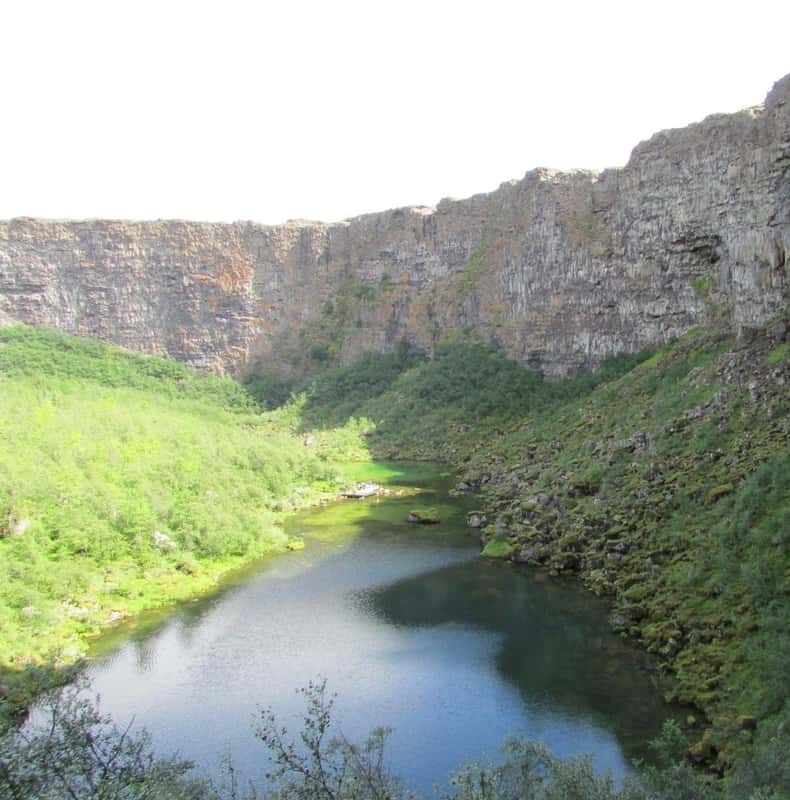
Ásbyrgi is a horseshoe canyon 3.5 kilometres long, with cliffs reaching a hundred metres at its head. Geology says catastrophic glacial floods, one eight to ten thousand years ago and another about three thousand. Norse tradition says Sleipnir, Odin's eight-legged horse, put down a hoof. The national park gives both, in that order, without adjudicating — which is the right way round.
9. There is nothing to buy, and that is now unusual
No admission charge, no parking fee, no café, no shop. As Icelandic sites have introduced parking charges one after another, Dettifoss has remained one of the last of the big ones without one. Enjoy it, verify it before you travel, and see visiting Dettifoss for what that means in practice.
10. The canyon is a World Heritage Site because of what made it
Jökulsárgljúfur became a national park in 1973, merged into Vatnajökull National Park in June 2008, and was inscribed on the UNESCO World Heritage List in July 2019. The citation is the interaction of ice and volcanic activity — which is exactly the process that cut the gorge you are standing in. How Dettifoss was made follows it through.
11. The pseudo-craters you drive past are not craters
On the way in you will stop at Skútustaðagígar, on the southern shore of Lake Mývatn, and your guide will call them pseudo-craters. Nothing erupted through them. About 2,300 years ago a lava flow ran out over waterlogged ground, the water underneath flashed to steam, and the steam blew out through the surface in a series of explosions. What you are walking round is the shape those explosions left.
There are more than fifty of them, and it is the largest and best-preserved field of its kind in Iceland. You will find the same formation in Hawaii, in the Azores — and, according to the operators who tell you this, on Mars.
12. Nobody has to let you in, because nobody owns the view
This is the fact that surprises people who have paid for Gullfoss parking or queued at the Blue Lagoon. Dettifoss has no gate, no booth and no barrier, and as of 2026 no parking charge either, on either side. You can arrive at four in the morning in June and stand there in full daylight with nobody to ask.
What you cannot do is buy a coffee, shelter from the rain or get a signal. If you would rather somebody else handled the two hours of driving and the road conditions, Dettifoss Tours compares every guided departure by the minutes it gives you at the rim.
Tours that fit this trip
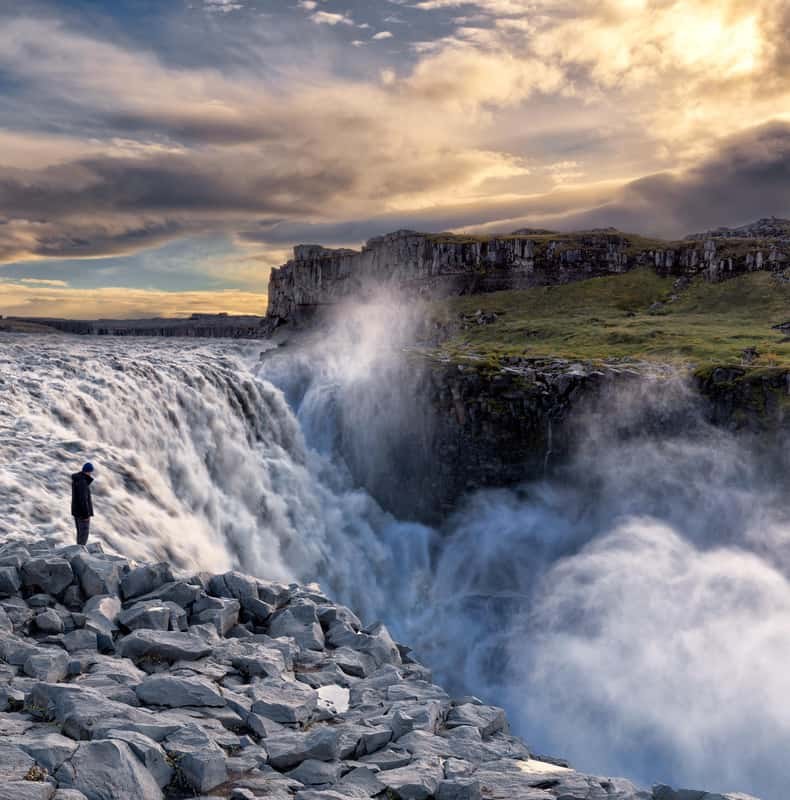
From Akureyri Port: Diamond Circle Guided Day Trip w/ Lunch
Lunch includedCruise pier80 minutes at the falls
From $209 per person
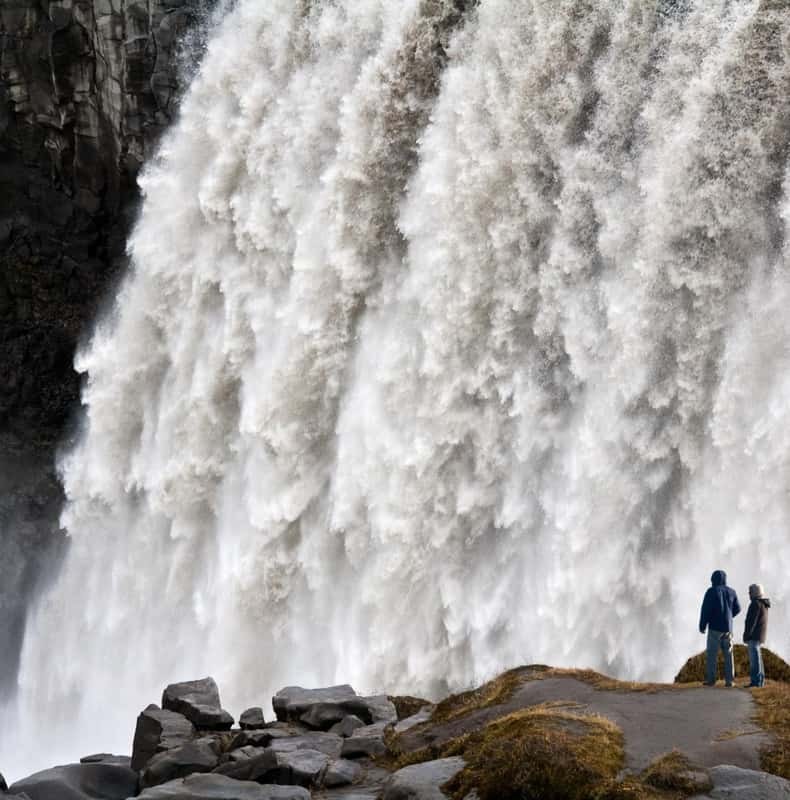
Akureyri Port: Dettifoss, Goðafoss and Lake Mývatn Tour
Max 15Lunch includedCruise pier
From $278 per person
Want the stories told properly on the day? Every guide on these departures does this for a living. See the tours