Three Waterfalls on One River: Dettifoss, Selfoss and Hafragilsfoss
Short answer. Three waterfalls sit within about three kilometres of each other on the Jökulsá á Fjöllum. Selfoss is 600 metres from the west-side signpost and takes forty minutes return. Hafragilsfoss is two kilometres downstream and needs the east road, which is shut all winter. Most visitors see one of the three.
Dettifoss is the one everybody photographs, and it is the middle one. Book a Dettifoss waterfall tour and it is the one you will be taken to. A kilometre upstream is Selfoss, and about two kilometres downstream is Hafragilsfoss. All three are the same river doing the same thing at different stages of the same process, and the walk between two of them is signposted, easy and takes less than an hour.
The three, at a glance
| Drop | Where | Reached from | Time to add | |
|---|---|---|---|---|
| Selfoss | 10 m | about 1 km upstream | West side, on foot | 40 min return |
| Dettifoss | 44 m | — | Both sides | — |
| Hafragilsfoss | 27 m | about 2 km downstream | East side, by road | 20 min, summer only |
Selfoss — the one worth the walk
Ten metres high and far wider than it is tall. Where Dettifoss is a single curtain going over one straight lip, Selfoss is a horseshoe of many separate strands pouring off stepped basalt ledges on both banks. The two look nothing alike, which matters more than it sounds: a great many photographs captioned Dettifoss on the internet are actually Selfoss.
Getting there is straightforward. From the junction on the west side the signpost reads Selfoss 0.6 kilometres, against 0.2 for Dettifoss. The national park rates the Dettifoss–Selfoss circuit as about 2.5 kilometres, roughly an hour, and easy. The surface is basalt pavement, uneven in places, and it is the same rock that ices in the shoulder season.
🏛 Did you know? The three waterfalls are one process at three stages. Dettifoss undercuts and collapses the basalt columns at its lip, so it retreats upstream at about half a metre a year. Hafragilsfoss sits where the falls used to be; the canyon has had time to widen around it. How the canyon was made follows the whole sequence.
Hafragilsfoss — the one almost nobody sees
Twenty-seven metres, deeper into the canyon, and viewed from a rim viewpoint on Route 864 rather than from beside the water. The reason so few visitors see it is simple: that road is gravel and closes from the first autumn snow until around the end of May. If you are on the east side in summer it is a short detour, and the canyon walls here carry iron-oxide reds that the west side does not show.
Which side gets you which
- West side, Route 862. Dettifoss and Selfoss, on foot, from the same car park. Paved road, toilets, and the only option every guided departure uses.
- East side, Route 864. Dettifoss head-on and Hafragilsfoss from the rim. Gravel, no facilities, and shut for over half the year.
- Both. Possible, and it costs about two and a half hours of driving because there is no bridge at the falls.
Roads and access has the full comparison, and the map page shows where each viewpoint sits.
Doing all three in one day
You can, in summer, driving yourself, and it makes a long day. Start on the west side early: Dettifoss, then Selfoss, then back. Drive round to the east side — two and a half hours — for the head-on view and Hafragilsfoss. That is most of a day and a great deal of gravel, and it only works between about late May and the first autumn snow.
On a guided departure you get the west side, which means Dettifoss and, if the stop is long enough, Selfoss. Ninety minutes is enough; forty is not. Dettifoss tours from Akureyri lists the departures by exactly that number.
What each one is called, and why
Icelandic waterfall names in this canyon are literal to a fault. Dettifoss is from detta, to fall or collapse. Selfoss takes its name from the ledge it spills over. Hafragilsfoss is named for the ravine it sits in. Even Jökulsárgljúfur is simply the glacial river's canyon. Ásbyrgi, the shelter of the gods, is the only name here reaching for anything else — and it is the one with the horse legend attached.
💡 Useful tip. If your day tour gives you eighty or ninety minutes at Dettifoss, ask the guide at the car park whether Selfoss is realistic before you set off. On a long stop it usually is, and it is the difference between seeing the famous one and seeing the river.
Why so many photographs are mislabelled
Once you have stood at both, the confusion is hard to credit — and then you look at a search results page. Selfoss is wide, low and made of many strands; Dettifoss is one curtain over a straight lip. But both sit in the same black canyon, both are shot from the same west-side path within twenty minutes of each other, and one of them is famous. So the famous name gets attached to whichever photograph came back best.
It is worth knowing before you go, because it changes what you expect. If the image that made you want to come here shows a broad horseshoe of small falls, the place you are picturing is 600 metres upstream of the one your tour is stopping at, and you will need to walk.
Timing the walk on a guided day
| Time at Dettifoss | Realistic? | What to do |
|---|---|---|
| 30–40 minutes | No | The viewpoint and back. Do not start the Selfoss path. |
| 60 minutes | Tight | Possible at a brisk pace with no photography stops. |
| 80 minutes | Yes | Comfortable if you go to Selfoss first and Dettifoss on the way back. |
| 90 minutes | Yes | Both falls properly, with time at each. |
The trick on a long stop is to walk to Selfoss first while everyone else is at the main viewpoint, then take Dettifoss on the way back when the crowd has moved on. Ask your guide at the car park rather than assuming — some will time the stop around it if you say so at the start.
Getting the photographs
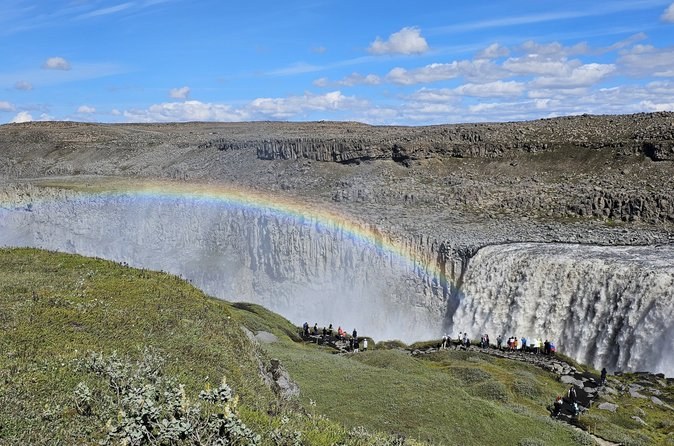
Dettifoss photographs best from the west rim in the early afternoon, when the sun stands behind you and puts a rainbow in the spray. Selfoss wants a wider lens and rewards a low angle from the basalt pavement. Hafragilsfoss is a rim shot and a long lens. All three are wet work: the spray at Dettifoss reaches the lower viewpoint, which is why the gallery is captioned to show which waterfall is which.
If the three-waterfall walk is the reason you are going, pick a departure on Dettifoss Tours that gives the falls eighty minutes or more — every card states the figure.
Tours that fit this trip
Lake Mývatn and Powerful Dettifoss Day Tour from Akureyri
Max 12Pickup1.5 hours at the falls
From $401 per person
One departure names Selfoss on its own itinerary. If the walk upstream is what you came for, start there. See the tours