Dettifoss Through the Year
Short answer. June and July for daylight and open roads, September for colour and quiet, October to May for an empty canyon and a road you have to check. The flow peaks with the summer melt, the light swings from three hours to twenty-three, and the path ices from autumn to spring.
Five things move independently through the year at Dettifoss: the flow, the light, the ice, the roads and the crowds. Nothing peaks at the same time as anything else, which is why “when should I go?” has a real answer rather than a default one.
What actually changes
| Peak | Trough | Why it matters | |
|---|---|---|---|
| Flow | May–July, with the melt | Late winter | Volume is what makes the sound |
| Daylight | 23h 23m in mid-June | 3h 08m in mid-December | A two-hour drive at each end of it |
| Ice on the path | January–March | June–September | The commonest complaint about a visit here |
| Route 862 | April–December in service | January–early April not | Decides whether you get there |
| Route 864 | Late May–first snow | The rest of the year | The east rim, and Hafragilsfoss |
| Crowds | Midday, July–August | Any hour, November–March | The west viewpoint is not large |
Spring: April and May
April is the month the road comes back. Winter service resumes on Route 862 at the beginning of it, daylight passes fifteen hours, and precipitation drops to its annual low of about 25 mm. The east road is still shut and will be for weeks. May adds four more hours of daylight, the highest flow of the year as the melt arrives, and — usually late in the month — the reopening of Route 864, though that date moves annually and depends on mud drying rather than snow melting.
Spring is the underrated window here. Almost everything is open, the river is at its fullest, and the coach traffic has not arrived.
Summer: June, July and August
June gives twenty-three hours and twenty-three minutes of daylight at the falls' latitude, and it is the driest month at about 20 mm. July is the warmest, averaging a high of 15.1°C in Akureyri, and the busiest. August is barely cooler with seventeen hours of light, and it is peak cruise season, which fills the morning departures from the pier.
The trade is crowds. The Diamond Circle coaches converge on the west viewpoint around midday, and it is not a large platform. If you are driving, arrive before nine or after five — in June and July the light lasts and the car park does not.
💡 Useful tip. The midges arrive at Lake Mývatn in June and July, and every day tour stops there. They do not bite; there are simply a great many of them. A head net costs very little and makes the crater walk considerably more pleasant.
Autumn: September and October
September is the month to pick if you can choose freely. Thirteen hours of daylight, both roads usually still open, the moss on the rim turning, and the coach traffic thinning noticeably. Rainfall climbs to about 50 mm and the first aurora nights arrive. The caveat is Route 864, which can close at any point from September onward with no notice.
October is the handover. The east road goes, daylight drops under ten hours, rainfall peaks at about 75 mm, and the path begins to ice. Day tours still run from Akureyri, and the falls under low autumn light are worth a colder day.
Winter: November to March
November gives six hours of daylight and fifteen hours of sunshine in the entire month. December gives three hours and eight minutes at the falls, and Akureyri records no sunshine at all. January and February hold the same temperatures — a low of about −3.4°C and a high of 2.6°C — but February has nearly twice the light, which makes it the more workable of the two. March passes eleven hours and the road authority begins catching up with Route 862 again.
The river does not stop. Dettifoss carries glacial meltwater year-round and keeps running through the winter, though ice builds along the canyon walls and the spray coats everything near the viewpoint. Travellers reach the falls in February and March most years.
⚠ Route 862 is not in winter service from January to early April. That is not the same as closed — the road is paved and unbarriered, and it opens and shuts with the weather. Check vegagerdin.is on the morning you travel, or book a Dettifoss tour from Akureyri and let the operator decide, with a full refund if the answer is no. Every day tour listed refunds on that basis.
When is the waterfall at its most powerful?
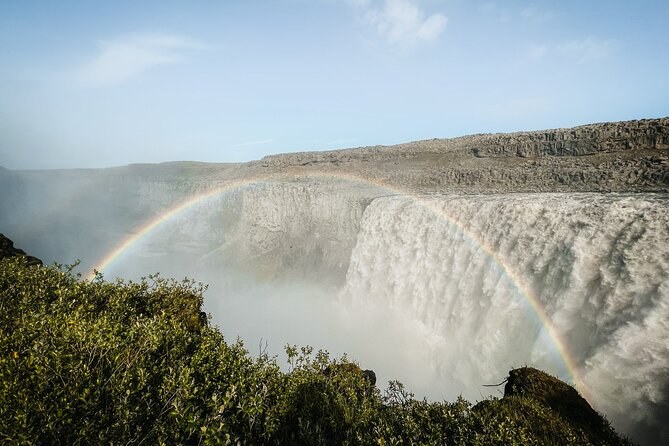
Late spring and early summer, when the melt from Vatnajökull is at its height. The 193 cubic metres a second you see quoted is an annual average; a glacier-fed river runs well below that in February and well above it in June. If volume is what you came for, May and June are the months.
When is it quietest?
November to March, by a wide margin, and September if you want quiet without the ice. The other lever is the hour rather than the month: even in July, eight in the morning at the west viewpoint is a different place from noon.
Can you see the northern lights there?
The sky over the canyon is as dark as any in Iceland, so in principle yes, between September and March. In practice none of the departures listed is a northern lights tour, and the ones that reach Dettifoss finish well before dark. Treat the aurora as something to chase from Akureyri in the evening, not from the falls.
What to wear, by season
| Season | Essential | Also worth it |
|---|---|---|
| June–August | Waterproof jacket, boots with grip | Head net for Mývatn, sunglasses |
| September–October | Full waterproofs, warm layers | Hat and gloves; the rim is exposed |
| November–March | Insulated boots with real grip | Micro-spikes, or a departure whose guide carries them |
| April–May | Waterproofs, warm layers | Something dry to change into |
How does the season change what you should book?
In July you have a genuine choice: drive it, book a seat, take the circle or stay on the Mývatn side. Every road is open and every departure runs. Your only real decision is how many minutes you want at the rim.
From October the choice narrows, and by January it has narrowed to one thing: book a departure whose operator makes the road call and refunds you if the answer is no. That is not a sales line, it is the shape of the problem — you are being asked to judge an unploughed road you have never driven, at seven in the morning, on a day you cannot repeat.
What should you expect the water to look like?
Brown-grey, in every month. The Jökulsá á Fjöllum carries glacial silt year-round and it never runs clear. What changes is volume and contrast: in June the falls are full and the moss around them is vivid green; in February you get less water, more ice on the walls, and black rock against white ground.
If you have a picture in your head of a blue Icelandic waterfall, that is not this one in any season. It is the thing first-time visitors are least prepared for, and it is worth knowing before you plan a photography trip around it.
Which months do the tours actually run?
Not one of the saved listings states an operating season, so we do not print one. What we can tell you is what travellers report: departures reach the falls in February and March, and one traveller describes a January day out. The cruise departures are bounded by the cruise season, which in Akureyri runs roughly May to September.
If your date is outside high summer, check availability on the operator's own calendar before you build a day around it, and take the free-cancellation window as your insurance rather than as a formality.
Which season for which traveller?
- First visit to Iceland, one shot: June to August. Everything is open and every departure runs.
- Photographers: September for colour, or February for ice and low light, with grip on your boots.
- Anyone who dislikes crowds: September, or an early start in summer.
- Cruise passengers: your date is chosen for you, and it will be between May and September.
- Anyone chasing the fullest river: May and June.
Frequently asked questions
What is the best month to visit Dettifoss?
September, if you can choose freely: thirteen hours of daylight, both roads usually open, autumn colour on the rim and far fewer coaches. June and July are the safe choice if you want everything open and warm.
Can you visit Dettifoss in winter?
Yes, with conditions. Route 862 is not in winter service from January to early April, and the path ices. Travellers reach the falls in February and March most years, usually on a guided departure whose operator makes the road call.
Does Dettifoss freeze?
The river does not stop. It carries glacial meltwater all year and keeps running through winter, though ice builds along the canyon walls and coats the ground near the viewpoint.
When is Dettifoss most powerful?
Late spring and early summer, with the melt from Vatnajökull. The 193 cubic metres a second usually quoted is an annual average, not a constant.
How dark is it at Dettifoss in December?
About three hours and eight minutes of daylight in mid-December, calculated for the falls' own latitude of 65.8 degrees north. Akureyri records no sunshine hours at all for the month. Any December visit is a narrow window either side of midday, with a two-hour drive at each end of it.
If you can only come once
Come in September. You get thirteen hours of daylight, both roads usually open, the moss on the rim turning bronze, and a fraction of the August traffic. The river is past its summer peak but still carrying plenty, and the ice has not arrived. It is the month that asks least of you and gives back most, and it is the one we would book.
For the month-by-month detail, Dettifoss weather and the best time to visit. For what the road is doing, roads and access. For departures that run whatever the month, Dettifoss Tours.
Tours that fit this trip
Cruise Tour Godafoss and Myvatn Lake and Dettifoss Small Group
Max 19Cruise pier40 minutes at the falls
From $273 per person